
Your plumber in Gresham, minutes from our shop.
Gresham begins where Portland’s east side leaves off, and Panda Plumbing works out of NE Portland’s 97230, right against that line. Stark, Glisan, and I-84 all run from our shop into your neighborhood, usually a ten to fifteen minute drive. That closeness is the whole point: it lets us promise Gresham homeowners an exact 30-minute arrival slot and keep it, job after job.
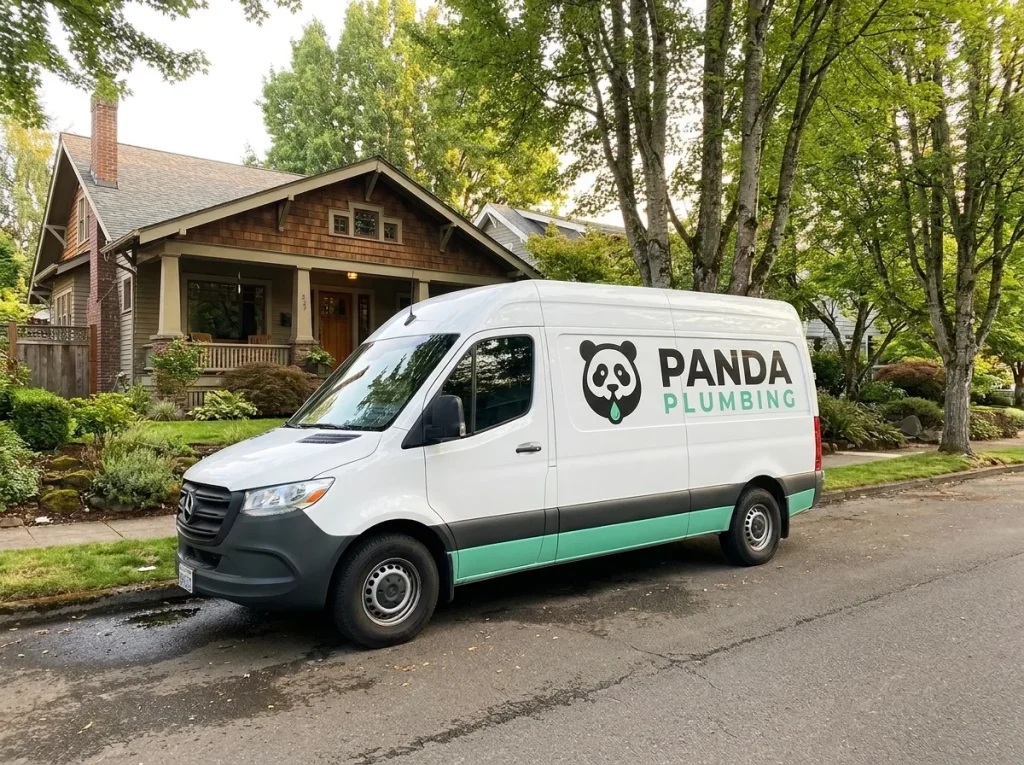
A Gresham plumbing company in everything but the mailing address.
Rockwood grew up around the corner of Stark Street and 181st Avenue, a spot once known as the ten-mile mark from Portland’s courthouse. That old nickname still describes the trip. Measured from our shop on the east side, most of Gresham sits closer to us than much of Portland does, so calls here never get squeezed in between cross-town jobs. They are the short drives our whole schedule is built around.
The city a plumber meets today was mostly built in one long postwar run. Gresham jumped from about 4,000 residents to more than 10,000 during the 1960s alone, and it kept growing until the 2020 census counted 114,247 people across 44,005 homes, a little over half of them detached single-family houses. Only about 4.4 percent of the housing predates 1950, and just 12.7 percent went up between 2000 and 2009. The center of gravity is unmistakable: a median build year of 1981.
That median is the most useful number on this page. It means whole streets of 1960s, 70s, and 80s ranches and split-levels are carrying original galvanized supply lines, first-generation drains, and water heaters running years past their design life, all aging on the same clock. Add a change in the water itself, covered below, and Gresham is exactly the kind of territory a service-focused shop should live next to.
Gresham at a glance
- 1981 median build year across the city’s housing stock
- 114,247 residents at the 2020 census across 44,005 homes
- 16 recognized neighborhoods, Rockwood out to Hollybrook
- Two water providers: City of Gresham and Rockwood Water PUD
- Primary supply switched to Cascade Well Field groundwater in 2026
- Ten to fifteen minutes from our shop via Stark, Glisan, or I-84
Gresham water heaters just got new water.
For decades, Gresham drank Portland’s Bull Run water. That ended in spring 2026, when the city, working through the Cascade Groundwater Alliance, made groundwater its primary supply, pumped from the Cascade Well Field roughly 600 feet down in the Sand and Gravel Aquifer. Rockwood Water PUD, the district serving about 62,175 people across parts of Gresham, Portland, and Fairview, moved even sooner and has run on 100 percent groundwater since March 2026.
You do not have to take a plumber’s word for what that means. The city itself describes the new supply as “soft to moderately hard,” tells residents they may notice spots on dishes or glassware along with buildup on fixtures, and notes that disinfection changed from chloramine to free chlorine. Those spots are minerals, and the same minerals collect wherever water sits and heats.
Inside a tank, that means sediment settling faster onto the steel above the burner. Inside a tankless unit, it means scale creeping across the heat exchanger. Neither is a crisis. Both are a maintenance schedule. Our water heater team handles flushes, repairs, and replacements tuned to the new water, and our tankless water heater service puts descaling on a calendar instead of a someday list.
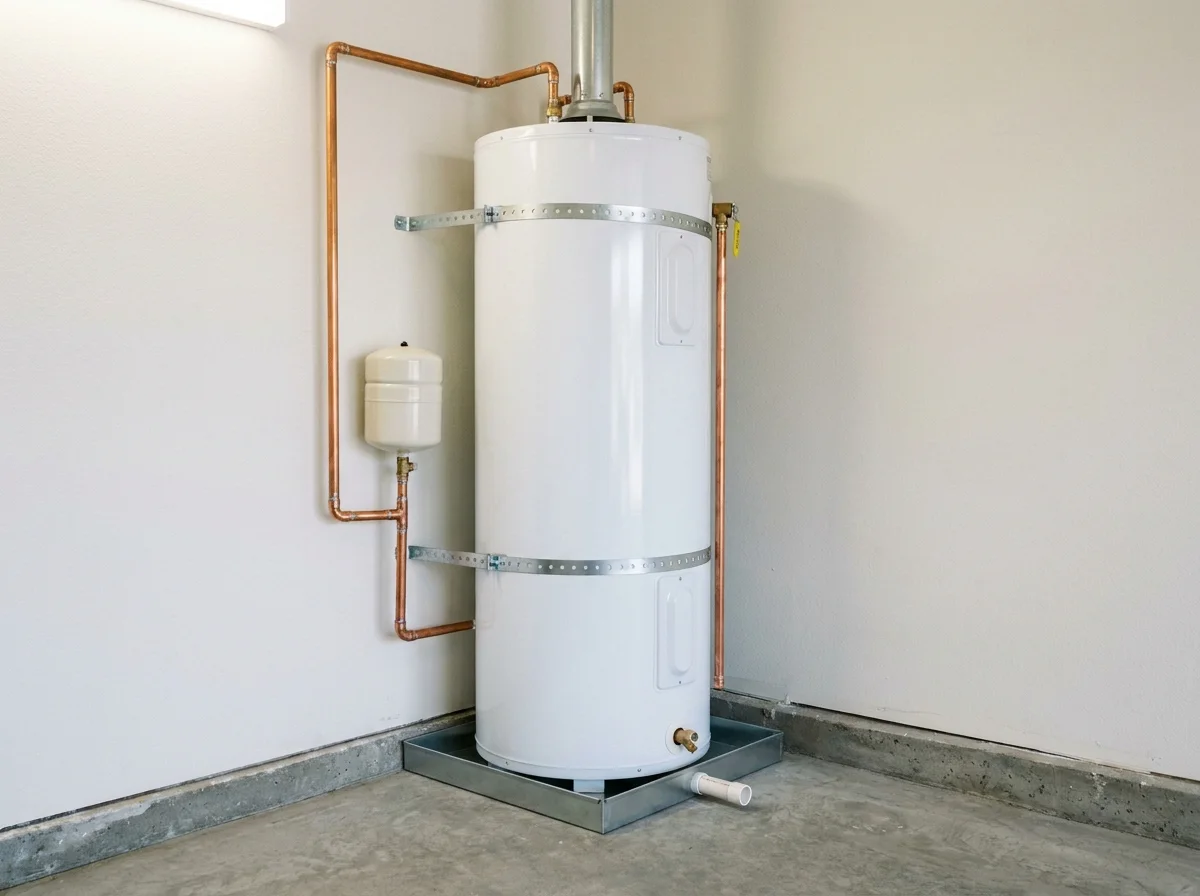
A flush with a new job
A yearly drain-and-flush was easy to skip on the old supply. On water the city calls soft to moderately hard, it is the simplest insurance a Gresham tank can get.
Descaling, on the calendar
Scale on a heat exchanger cuts hot water output and can put a tankless warranty at risk. A set descaling schedule protects the unit and the paperwork behind it.
Spots are the memo
Spotted glassware and crusted aerators are exactly the signs the city predicted, and they mirror what is forming inside the heater. See them outside, and it is time to look inside.
Whole-house repipes for Gresham’s galvanized generation.
Rockwood tells Gresham’s building story in one neighborhood. Berry farms until after World War II, apartments arriving in the 1950s, large mobile home parks by the 1960s, then steady building through the 1970s. The average Rockwood home went up around 1978, and 1970s split-levels and postwar ranches still set the tone on its streets. Powell Valley runs on a similar clock, and one look at the name Historic Southeast tells you which side of the city’s 1981 median that neighborhood calls home.
Houses from those decades were routinely supplied with galvanized steel pipe, and galvanized fails from the inside out. Rust narrows the bore a little more every year, so the shower collapses the moment someone opens a second faucet, and the first draw of the morning runs the color of weak tea before it clears. You cannot clean it away, and new fixtures do not help, because the restriction is the pipe itself.
The permanent fix is a whole-house repipe: new PEX or copper from the water heater to the last fixture, quoted as an exact written price before we open a single wall, with the home protected to our Concierge Site Protection standard while we work.
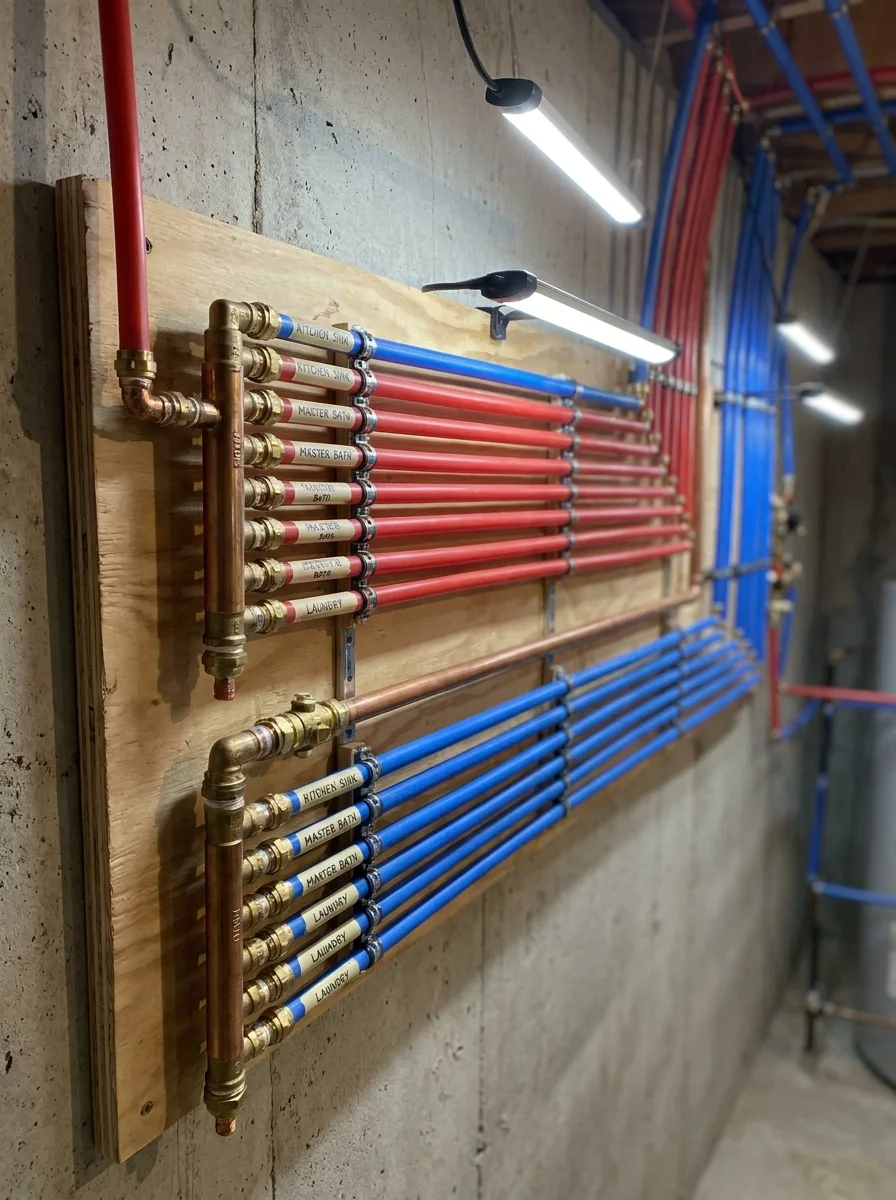
Pressure that folds
Strong flow at one fixture that collapses when a second one opens is the classic signature of a supply line rusting shut.
Rust in the first draw
Discolored morning water that clears after a minute is iron shedding off the inside of galvanized pipe, not something arriving in the city supply.
Repairs that multiply
When pinhole leaks and patched fittings start arriving yearly, each fix is buying less time than the one before it.
A pre-1980 birth year
If the house went up before 1980 and the supply lines were never replaced, assume galvanized until an inspection proves otherwise.
The line under the front yard is usually the same age
Galvanized-era plumbing does not stop at the foundation. The buried run between the water meter and the house is often original too, which is why we treat main water line replacement as a featured, stand-alone service with its own page and pricing, never a repipe add-on. If your pressure problems start at the meter, that is the page to read next.
Remodel plumbing for Gresham houses worth keeping.
A city where the MAX Blue Line runs nine stations deep, from the Rockwood/E 188th stop out to the end of the line at Cleveland Avenue, is a city people invest in rather than pass through. We see it on the schedule: owners of solid 1970s and 80s houses deciding the street is perfect and the hall bathroom is not.
Our remodel plumbing service is the trade half of those projects: relocating supply and drain lines for a new layout, setting the valves behind a modern shower, roughing in a wall-hung toilet or a second vanity, and leaving your tile and cabinet trades a clean, correct canvas. Kitchens get the same care, from relocated sinks to filtered drinking water lines. It is the work we feature first for a reason, and in homes this age it often pairs naturally with the repipe conversation above: open walls are cheap real estate.
All 16 neighborhoods, one arrival promise.
Gresham recognizes sixteen neighborhoods, and we cover every one of them, from the blocks around Main City Park to the streets up by Hogan Butte Nature Park. There is no inner zone and outer zone here: the exact 30-minute slot holds on every street in town.
Seven name-checked, sixteen served. If your address says Gresham, you are on our list.
Straight answers for Gresham homeowners.
How fast can you actually get to Gresham?
Did Gresham’s water really change?
My Rockwood house still has galvanized pipe. What now?
Do you serve all of Gresham?
More questions? Browse every answer on our FAQ page.